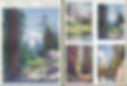
| From around 1910, the couple made annual summer visits to the Monterey Peninsula, where they maintained a house and studio. The relaxed social atmosphere and inspiring landscape resulted in numerous paintings that exploited the aesthetic possibilities of the seacoast. The distinctive light and color indigenous to the region brought forth more intensity of color to Mathews’ low-toned palette, and the many paintings he made of stands of cypress trees along the Monterey coast remain today among his most popular tonalist paintings. The Oakland Museum of California is home to an incomparable collection of works by both Arthur and Lucia Mathews. This set includes twenty assorted 5 x 7" blank notecards (5 each of 4 styles) with white envelopes in a decorative box. |
| William Seltzer Rice (1873–1963) was born in Pennsylvania but moved to Northern California in 1900, when the region’s Arts & Crafts movement was flowering. A talented and prolific watercolorist, Rice taught at various schools in the San Francisco Bay Area, including the California College of Arts & Crafts in Oakland—a center for the movement. He became devoted to block printing because compared with original watercolors, prints better suited the Arts & Crafts ethos of making artwork available to a wide audience at modest cost. Unlike many printmakers, Rice designed, carved, and printed the blocks all himself. The landscapes of Northern California—from the Sierra Nevada to the Pacific— proved excellent raw materials for his creativity, and his prints today can be found in public and private collections worldwide. This set includes twenty assorted full-color 5 x 7" blank note cards (five each of four styles) with envelopes and decorative box. |
| Born at the height of the Industrial Revolution, William Joseph "Dard" Hunter (American, 1883–1966) went on to become one of the most influential designers in America's Arts and Crafts movement—a discipline dedicated to shunning mass production in favor of simple and elegant handicrafts. At age twenty-one, Hunter talked his way into a summer job at the famed Roycroft art colony in East Aurora, New York. He remained at Roycroft for several years, thriving under the influence of founder Elbert Hubbard and the many notable artists and craftspeople who either lived there or visited. This collection of notecards features four adaptations of designs Dard Hunter created to add simple elegance to books. |
| Card assortment featuring four adaptations of designs by Dard Hunter (1883–1966). Hunter was one of the most influential designers in America’s Arts and Crafts movement, which shunned mass production in favor of simple and elegant handicrafts. This set includes twenty assorted 5 x 7" holiday cards (5 each of 4 designs) plus envelopes in a decorative box. Printed on recycled paper. |
| Ceramics played a large part in the early- twentieth-century American Arts and Crafts movement. The Midwest, home to Pewabic Pottery, Rookwood, Shawnee, Flint Faience, and many other studios, was a major center for art pottery. With its studio in Ann Arbor, Michigan, Motawi Tileworks upholds the rich Midwestern tradition of creative, elegant work in clay. Motawi artisans produce fresh and innovative tile designs that preserve the distinctive aesthetic flavor of Arts and Crafts, with deceptively simple lines and a rich palette of “organic” colors. Four of Motawi’s classic works are featured here. This set includes twenty 5 x 7" blank note cards (5 each of 4 styles) with envelopes and decorative box. |
| Inside message: Season's Greetings. Includes cards: Silver Silence, Big Trees in Snow, Sierra Winter, and Cedar in Snow. This set includes twenty assorted 5 x 7" holiday cards (5 each of 4 designs) plus envelopes in a decorative box. Printed on recycled paper. |
| Contains five each of the following notecards: Adaptation of cover design for The Book of The Roycrofters, 1907 Adaptation of cover of The Roycrofters Motto Book, 1908 Adaptation of design for Green's Cigar Book Adaptation of title page of The Rubaiyat of Omar Khayyam, 1908 |
| This set includes twenty assorted 5 x 7" blank notecards (5 each of 4 styles) with envelopes in a decorative box. |
| Though he might have made a bigger name for himself in some international art capital, Arthur F. Mathews (American, 1860–1945) steadfastly rejected the idea of leaving California. He once remarked that he would rather live and work in San Francisco than wear medals in Paris—and he had done both. A lifelong artist, influential teacher, and tireless civic-arts advocate, Mathews and his wife, artist Lucia K. Mathews, developed the California Decorative Style--a signature fusion of turn-of-the-twentieth-century Art Nouveau and Arts and Crafts styles. |
| Arts And Crafts Style Note Cards and Postcards |
![]() |
![]() |
![]() |
![]() |
![]() |
|
|
|
|
![]() |
|
|
| FOR QUANTITIES OF 4 OR MORE OF THE SAME STYLE AND COLOR PLEASE INQUIRE FIRST |
| ALL ITEMS ARE IN STOCK AND READY TO SHIP UNLESS OTHERWISE SPECIFIED |

| All Items Are Shipped Via USPS or UPS And Are Fully Insured |
| Copyright © Artsandcraftsman.com , Arts And Craftsman Woodworks. All Rights Reserved. |


|
|
![]() |
| Frank Lloyd Wright (American, 1867–1959) loved to work in glass. He regarded it as “the materialization of light, the weightless medium of sight,” and used it in innovative ways, providing a glinting counterpoint to the solid mass of traditional building materials. Over the course of a long career, Wright expanded his use of glass, diminishing the visual barrier between inside and outside and creating dazzling effects of light within his houses. This set of notecards presents four designs adapted from Frank Lloyd Wright’s work in art glass. These geometric patterns represent some of his most spectacular ornamental achievements. |

![]() |

![]() |
![]() |